Before the open or after the close: why earnings timing matters
· Both strategies · 5 min read · OptionsWave Research
For regular-session measurement, a report before the open counts on that day's session, and a report after the close counts on the next exchange session. That one detail decides which session counts as the reaction, which option expiry covers it, and when a post-earnings signal can start, so OptionsWave checks the timing of every report it uses.
The three kinds of timing
Before the market opens. The report comes out in the morning, before the 9:30 a.m. New York open. The first regular session after the news is the same day.
After the market closes. The report comes out after the regular close, usually within an hour or two. The close is usually 4:00 p.m. New York time, or 1:00 p.m. on scheduled early-close days. The first regular session after the news is the next exchange session.
During the session, or unknown. A few companies report while the market is open, and some calendars do not say when a report comes out. In either case, it is not clear which regular-session prices were set before the news and which after.
Prices can react outside regular hours too, in the pre-market or after-hours trading. OptionsWave measures regular sessions only, so the question is which regular session is the first one after the news.
The reaction session
OptionsWave calls the first regular session after a report the reaction session.
| Timing | Report day | Reaction session | Reference close |
|---|---|---|---|
| Before the open | Tuesday | Tuesday | Monday's close |
| After the close | Tuesday | Wednesday | Tuesday's close |
| After the close | Friday | Monday, or Tuesday after a Monday holiday | Friday's close |
The reference close is the last regular close before the news. Every move is measured from it.
Sessions come from the New York Stock Exchange calendar, so weekends and exchange holidays are skipped. A report after the close on the Wednesday before Thanksgiving, for example, reacts on the Friday, a shortened session that closes at 1:00 p.m.
Why the wrong timing gives the wrong answer
Suppose a company reported after Tuesday's close, and the stock rose 9% on Wednesday.
If a calendar wrongly marks the report as before the open, the reaction session becomes Tuesday, a quiet day before the news. The past move for that quarter would show as perhaps 1% instead of 9%. One quarter like that pulls a four-report average down by two points, enough to turn a candidate into a pass.
The same error moves the expiry. The volatility scanner prices the straddle in the earliest expiry that includes the reaction session; with the wrong session, it can pick an expiry that ends before the stock has reacted at all.
How OptionsWave handles timing
The past reports are strict. Each of the four past reports used for the past move needs a known before-the-open or after-the-close timing. A past report with unknown, conflicting or during-the-session timing leaves the stock out of the scan, and an older report is never used to fill the gap.
The coming report can be unconfirmed. When no source names the coming report's timing, the stock can still be a candidate or a pass, flagged as timing unconfirmed. The scanner then picks an expiry that covers the session after the report date as well, so it reaches the reaction whichever way the report comes out.
Conflicting sources skip the coming report. When sources disagree on the coming report's timing, the scanner does not pick one; that event is skipped.
A missing stock is a gap in the data. A stock left out is not rated either way; the missing stocks article lists every reason. The company's own announcement is the place to check a report's timing.
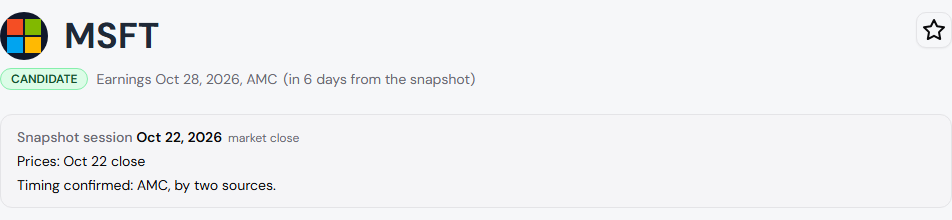
Every evidence page states the snapshot session and how the coming report's timing was confirmed: here, after the close, by two sources.
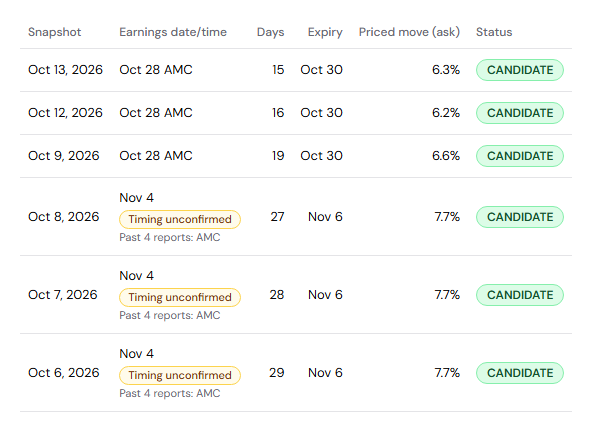
MSFT in the scanner history (selected columns). Until October 8, 2026 the calendar showed November 4 with no timing, so the expiry covered the following session. From October 9 the report was confirmed for October 28 after the close, and the expiry moved to October 30.
Timing and the option expiry
For a report after Thursday's close, the reaction session is Friday. Many stocks have weekly options that normally expire on Friday, or on Thursday when Friday is an exchange holiday, so the earliest expiry that includes the reaction is often that same Friday.
That straddle has very little time left after the report. Its price still covers the time between the scanner's snapshot and the report, which can be days or weeks. For a report after Friday's close, the reaction is on Monday, and the earliest expiry is usually the following Friday, which also covers four ordinary sessions after the reaction. The same company can show a different implied move depending on the weekday it reports, for reasons that have nothing to do with the company.
Timing and post-earnings signals
The PEAD rule uses the same reaction session. A signal needs the reaction session to close above the reference close, and the model's planned entry is the open of the session after it.
| Timing | Report day | Reaction session | Planned entry |
|---|---|---|---|
| Before the open | Tuesday | Tuesday | Wednesday's open |
| After the close | Tuesday | Wednesday | Thursday's open |
With the wrong timing, the rule would judge the wrong day's close, and enter a day early or late. The PEAD timing article walks through a full example.
How to check a report's timing yourself
- The company's investor relations page announces the date and usually says "before the market opens" or "after the market closes", often with the time of the conference call.
- The press release time stamp on the newswire shows when the numbers came out.
- The price bars can help check consistency, but they cannot establish when the report came out.
When sources disagree, the company's own announcement wins.
In short
Timing decides which regular session reacts. Get it wrong, and the past move, the expiry and the PEAD entry are all measured on the wrong day. That is why OptionsWave requires a known timing for every past report, covers an extra session when the coming report's timing is unconfirmed, and leaves a stock out rather than guess.
A past move is not option profit.
Each PEAD signal is a model signal, not advice.
Nothing on OptionsWave is investment advice.