IV crush: why a right call on the move can still lose
· Volatility play · 5 min read · OptionsWave Research
IV crush is the drop in an option's implied volatility that often follows an earnings report, once the uncertainty it carried is resolved. It can take much of a straddle's value away the morning after the report, so a stock can make a large move and the straddle can still be worth less than it cost.
This article explains where the drop comes from, puts numbers on it, and shows what it means for reading a past move next to an implied move.
Why options get expensive before a report
An option's price depends on how far the stock might move before expiry. Implied volatility is the yearly volatility that makes a pricing model match the option's market price.
Before an earnings report, the expiries that include the report carry one known event that can move the stock a lot in a single session. Sellers charge for that event, so the implied volatility of those expiries climbs in the days before the report, often well above its usual level. Later expiries rise less, because the same event is spread over more ordinary days.
What happens when the report is out
Once the numbers are public and the stock has reacted, the event is over. What is left until expiry is ordinary days, and the market prices them as ordinary days. Implied volatility of the front expiry often falls sharply towards its usual level, frequently by the first open after the report, though how far depends on how much uncertainty the report leaves.
That fall is IV crush. It is not a market failure: the market had priced one large known event, and the event has happened.
A worked example
The numbers below are made up to show the mechanics; they are not a quote and not a forecast.
Before the report, the stock closes at $100. The $100 straddle in the expiry four sessions after the report costs $8.00, an implied move of 8%. All of that $8.00 is time value, and much of it is the price of the earnings event.
The morning after, suppose implied volatility has fallen to 35% a year, with four trading sessions left to expiry, no interest and no dividends. Priced with the standard Black-Scholes model under those assumptions, the same straddle is worth about:
| Stock after the report | Value from the price alone | Time value left | Straddle worth about | Against the $8.00 paid |
|---|---|---|---|---|
| $100 (no move) | $0.00 | $3.52 | $3.52 | about -56% |
| $106 (up 6%) | $6.00 | $0.39 | $6.39 | about -20% |
| $110 (up 10%) | $10.00 | $0.05 | $10.05 | about +26% |
At 30% the values are about $3.02, $6.21 and $10.01; the picture is the same.
Three things stand out.
A 6% move is a large reaction, and the straddle still lost about a fifth of its cost. The buyer was right that the stock would move, but the move was smaller than the 8% that was paid for.
With no move, more than half of the cost is gone in one session. The $3.52 left is time value for the four ordinary sessions to expiry, at an ordinary volatility.
Well beyond the implied move, the value from the price makes up for the lost time value. Once the stock is far from the strike, the straddle is worth mostly its value from the price, and little time value is left either way.
Why this matters for a past move
OptionsWave compares the average of the stock's largest move from the previous close in the reaction session, over its last four reports, with today's straddle cost at the ask as a share of the stock price. That comparison deliberately leaves IV crush out: it does not model how option prices change after the report, and it does not calculate an option return.
So read the gap with the table above in mind:
- A narrow gap can still lose. If the past move average is 8.5% against an 8% straddle, an ordinary reaction a little below the average leaves the straddle under water after the crush.
- The largest move is not where the stock stays. A stock that jumps 9% at the open and closes up 5% has a largest move of 9%, but the straddle is worth what the stock is at when you sell it.
- Every past reaction is a different day. Each of the four had its own volatility before and after. They show how the stock moved, not what a straddle on it returned.
This is why every historical figure on OptionsWave is labelled a past move, not option profit.
How OptionsWave shows the crush
The comparison stays simple on purpose, so it can be checked with two quotes and four price bars. Next to it, the evidence page has exit scenarios. Each one prices today's straddle at the close of a reaction day like one of the stock's last four: the stock moved by that report's close-to-close move, the implied volatility measured on that reaction day, the time left to expiry, and today's half-spread deducted. A scenario is unavailable when one of those inputs is missing.
The scenarios are a test of the idea, not a forecast. They ask whether the straddle would have held its value through a repeat of each past reaction once volatility is repriced, which is the question the simple comparison leaves open.
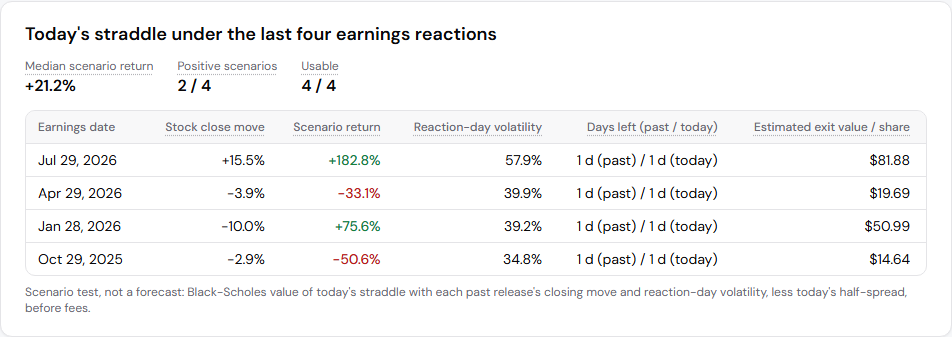
MSFT's straddle from the October 22, 2026 snapshot, priced under each of its last four reactions with that day's measured volatility. Two of the four come out positive. A scenario test, not a forecast.
What to check before you research a straddle
- The expiry. The first one after the report has the least ordinary time to pay for, but the steepest crush.
- How much of the straddle is the event. Compare the front expiry's implied volatility with the next expiry's. A large difference suggests much of the price is the report, and that much of it may go once the report is out.
- The closing moves, not only the largest ones. Look at where each of the four reactions closed, as well as how far it went.
- The exit scenarios. If the straddle loses value in most of the four repeats, the gap on the scanner says less than it seems to.
In short
Before a report, much of a straddle's price is the price of one event. When the event is over, that part usually shrinks, and the stock's move has to make up for it. At expiry, this $8.00 straddle breaks even at $92 and $108 before fees; before expiry, the time value still left also counts. A past move that beats the implied move is a reason to look closer, not a measure of what a straddle would return.
A past move is not option profit.
Nothing on OptionsWave is investment advice.