How OptionsWave picks a candidate, and why most names are a pass
· Volatility play · 5 min read · OptionsWave Research
OptionsWave marks a stock a candidate when the average of its last four earnings reactions is larger than the move its options price for the next one. Most stocks are a pass: in the scanner's first 16 sessions in production, about three in four classified results were a pass.
This article walks through each step of the scanner, and what that ratio says.
When it runs
The scanner runs before the open on every exchange session day, on the previous session's closing prices. It also runs on Saturday, on Friday's close. Every result names the session whose prices it used.
Step 1: which reports are next
The scanner reads the earnings calendar for the coming reports and checks each one's timing: before the open, after the close, or unknown. The timing decides which session is the reaction and which option expiry covers it.
When sources disagree on the coming report's timing, the scanner leaves that report out rather than guess. When no source states the timing, the stock is still rated, flagged as timing unconfirmed, and the expiry also covers the session after the report date.
Step 2: the stock's last four reactions
For each of the stock's last four completed reports, the scanner finds the reaction session and measures the largest distance from the previous close reached in that session, up or down, including the opening gap. It averages the four into the past move.
All four must be valid. If one is missing a price or has unclear timing, the stock is left out of the scan, and an older report is never used to fill the gap (why exactly four).
Step 3: what the options price
The scanner takes the earliest listed expiry that includes the reaction session, and the strike nearest to the closing price with both a call and a put. It adds the call's ask and the put's ask: what a buyer would have paid for the straddle at the close. Divided by the closing price, that is the implied move. It is an indicative price; anyone acting on it would need fresh quotes.
The contracts must be standard, from the right session, and have two-sided quotes that make sense: a bid above zero and no higher than the ask, matching strikes and expiries. Each leg's spread must be at most 20% of its midpoint, and at least one leg must have traded that day, or both legs must have an open interest of at least 100 contracts. A stock without usable quotes is left out of the scan.
Step 4: the comparison
The gap is the past move minus the implied move, in percentage points.
| Result | When |
|---|---|
| Candidate | The past move is above the implied move: an idea to research, not a recommendation |
| Pass | The past move is at or below the implied move |
A stock that fails a check is not rated and does not appear in the list (why a stock is missing). Candidates are ranked by the gap, largest first. There is no score, no weighting and no other input: the same two numbers decide every stock, and both can be checked.
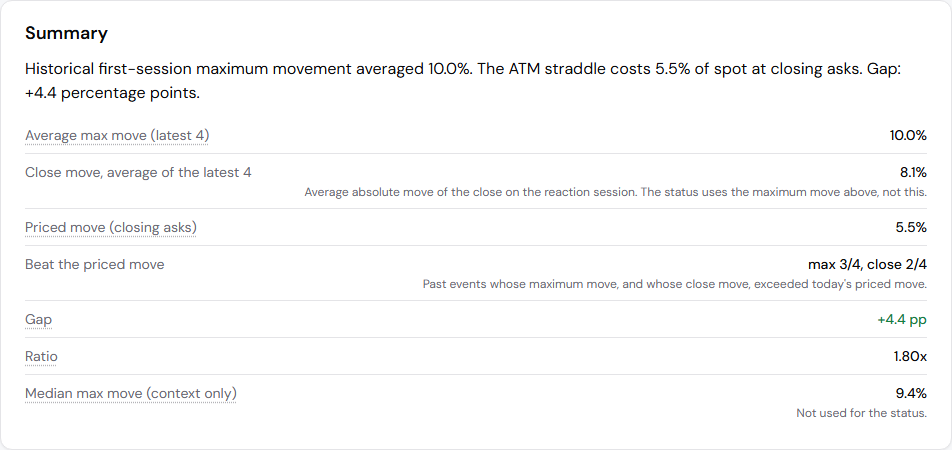
The comparison for MSFT on October 22, 2026: a 10.0% average maximum move against a 5.5% priced move, a gap of +4.4 points, so a candidate. An idea to research, not a recommendation.
What the first weeks show
From October 1 to October 22, 2026, the scanner stored 3,819 classified results over 16 sessions, read from the production database on October 23. A stock scanned on several sessions is counted each time; stocks the scanner left out are not stored, so they are not counted.
| Status | Results | Share | Average gap |
|---|---|---|---|
| Pass | 2,942 | 77% | -4.72 points |
| Candidate | 877 | 23% | +2.86 points |
Two things are worth noting.
Most names are a pass, even on a generous yardstick. The largest move in a session is usually bigger than the close-to-close move, so it flatters the past. Even so, the options priced a larger move than the stock's recent average in three results out of four. That fits what option pricing would lead you to expect: sellers charge for the risk they carry, so implied moves tend to sit above what stocks usually do.
The candidates' gaps are modest. An average gap of under three points is small next to an implied move that is often several percent. The gap alone does not estimate an option return; the IV crush a straddle takes after the report is a separate question, which the exit scenarios look at. A candidate is the start of the research, not the end of it.
These figures cover a few weeks of one autumn and are not a measure of how candidates performed.
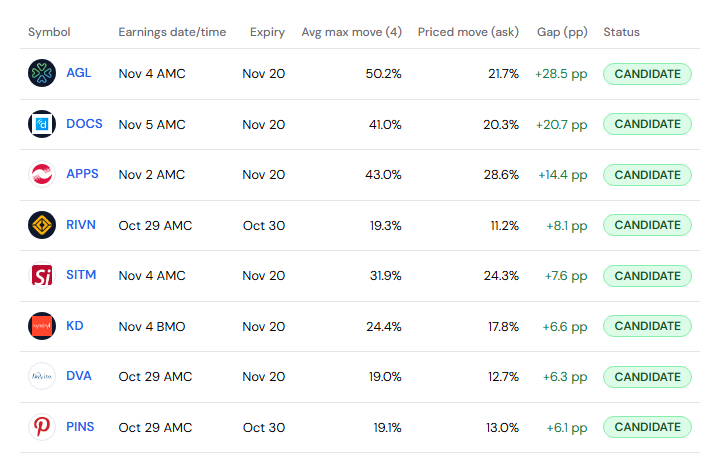
The top of the scanner after the October 22, 2026 close, ranked by gap (selected columns). Each row links to its evidence page.
Why the scanner stays this simple
A model with more inputs can fit the past better and explain itself worse. The scanner uses one comparison that a reader can reproduce from four price bars and two quotes, and it says plainly what it leaves out: it uses closing asks, with no volatility forecast and no separate adjustment for IV crush, the spread on the way out or fees.
What it leaves out is shown beside it instead:
- The evidence page lists each of the four reports with its prices, the average and the median, and the exact contracts and quotes used.
- Exit scenarios price today's straddle at the close of a repeat of each past reaction, with that day's implied volatility and today's half-spread deducted, as a scenario test, not a forecast.
- The payoff chart shows the profit or loss at expiry across stock prices, after the straddle's cost and any fees you enter.
- The outcome review records the largest move after each report and whether it was bigger than the implied move, labelled a review, because a realized move is not option profit.
How to use a candidate
- Read the four reactions, not only the average.
- Check how wide the gap is, and whether the median agrees with the average.
- Check the spread on the quotes and the open interest at the strike.
- Look at the exit scenarios.
- Read the company's recent news for anything that makes the next report unlike the last four.
The scanner sorts the week's reports so research time goes where the options price less movement than the stock has recently shown. Nothing on it is a trade call.
A past move is not option profit.
Nothing on OptionsWave is investment advice.