A research checklist before a long straddle on earnings
· Volatility play · 4 min read · OptionsWave Research
Researching an earnings straddle starts with its report timing, contract selection, quotes and potential loss. These ten checks explain the scanner's inputs and the limits of its comparison. This checklist is for research; it is not a recommendation to trade, and nothing on OptionsWave is.
What a long straddle is
A long straddle is one call and one put on the same stock, with the same strike and the same expiry, both bought. At expiry, it profits before fees when the stock's distance from the strike exceeds the total premium paid. Before expiry, its value also depends on implied volatility and the time remaining. The most it can lose is the premium paid, plus fees.
Before earnings, its price is the market's price for the size of the move. The implied move article explains how to read it.
1. The report time
Confirm the date, and whether the report comes before the open or after the close, on the company's investor relations page. The time decides which session reacts and which expiry covers it (why timing matters).
2. The expiry
The scanner selects the earliest listed standard expiry that includes the reaction session. A later expiry also covers ordinary trading days after the report, so its price holds more time value that the report itself does not explain.
3. The strike
Within that expiry, the scanner selects the strike nearest the snapshot close that has both a call and a put. It rejects a selected strike more than 5% from the snapshot close. That is its fixed limit for treating the straddle as near the money.
4. The quotes
Look at the bid and the ask of both options.
- A wide spread makes the trade cost more to enter and to leave.
- A bid of zero, or a bid above the ask, is not a usable quote.
- Low volume and low open interest at the strike can come with wide spreads.
OptionsWave uses closing asks from the snapshot session named on the result, and shows both sides of each quote. That session can be days or weeks before the report. The quotes are indicative: anyone acting on them needs fresh quotes.
5. The implied move against the past moves
Compare the straddle's cost as a share of the stock price with the stock's largest move on each of its last four reaction days.
- Read all four, not only the average.
- Compare the average with the median: a large difference means one report carries the result.
- Read where each reaction closed, not only how far it went.
A candidate on OptionsWave is a stock whose past move average is above its implied move: an idea to research, not a recommendation. The four reports article explains what that comparison can and cannot say.
6. How much of the price is the event
Compare the implied volatility of the earnings expiry with the next expiry's. A large difference suggests much of the straddle's price is the report itself, and that much of it may go once the report is out. That drop is IV crush.
7. The exit scenarios
OptionsWave's evidence page shows exit scenarios for the snapshot straddle. Each available scenario applies one of the last four reactions' closing moves to the snapshot straddle, prices it with that reaction day's measured implied volatility and the time remaining, then deducts the snapshot half-spread. When the snapshot straddle expires on the reaction day, the scenario uses its intrinsic value alone, with no implied volatility. A scenario row can be unavailable when one of its inputs is missing.
If the straddle loses value in most of the available scenarios, a candidate's gap says less than it seems to. The scenarios are a test, not a forecast.
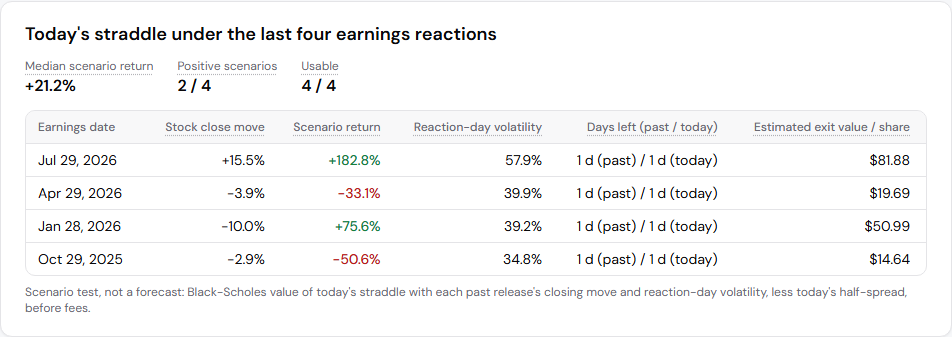
Exit scenarios for MSFT's October 30 straddle from the October 22, 2026 snapshot: each row repeats one past reaction. A scenario test, not a forecast.
8. The break-evens at expiry
At expiry, a straddle breaks even when the stock is above the strike by the premium, or below it by the premium. A straddle with a $100 strike and an $8 premium per share breaks even at $92 and $108 before fees.
OptionsWave's payoff chart shows the profit or loss at expiry across stock prices, after the premium and any fees you enter.
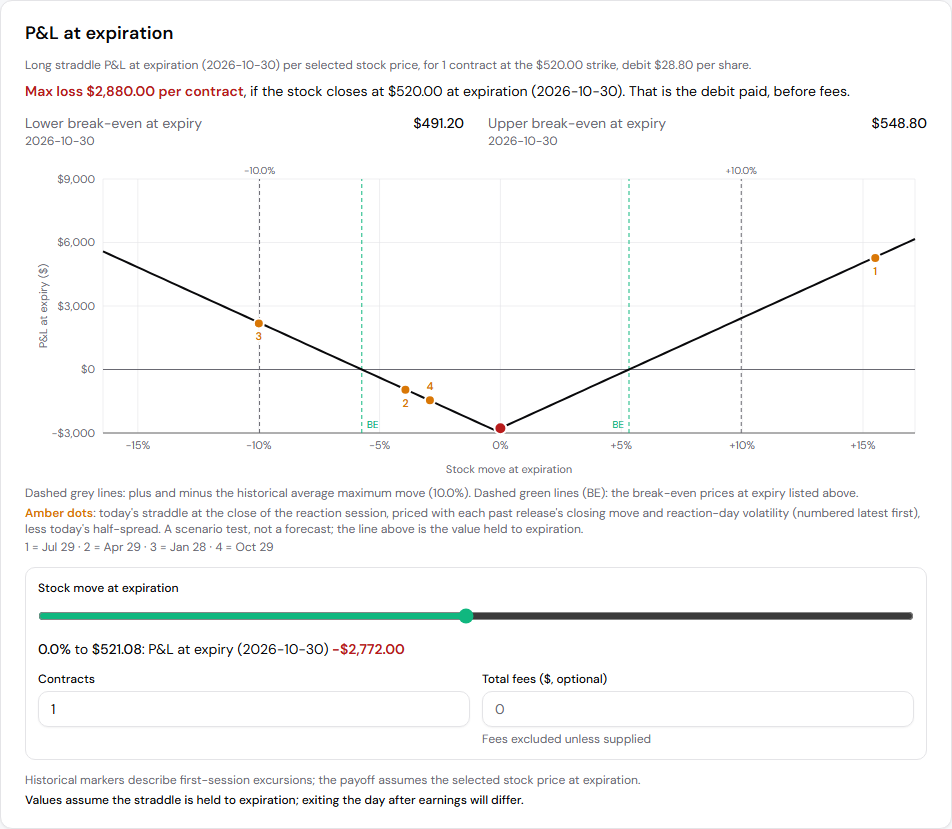
The payoff at expiry for one MSFT straddle at the $520 strike: break-evens at $491.20 and $548.80, and a maximum loss of the $2,880 debit if the stock closes at the strike, before fees.
9. The costs
Add commissions and fees for four trades: two options in, two out. Include the spread on the way out as well as on the way in.
10. How much you could lose
The entire premium can be lost if both options expire worthless with the stock at the strike; fees add to that loss. Size, if any, is a personal decision that depends on your own money and risk, and OptionsWave never suggests one.
After the report
Decide before the report when you would review the position: at the open, during the reaction session, or at expiry. Prices and spreads can change sharply around the reaction open.
In short
A long straddle before earnings is a position on the size of a move, paid for in advance, at a price that already includes the event. The ten checks show what that price is, how it compares with the stock's own record, and what has to happen for it to be worth more than it cost.
A past move is not option profit.
Nothing on OptionsWave is investment advice.